

Dubai is a majestic metropolis rising from the sands. In 2023, it presents itself as a place full of attraction for migration. The multicultural society, uniting over 200 nationalities, creates a colorful blend of Eastern ethnicity and Western lifestyle.
Work activity in Dubai is an interweaving of constant progress and knowledge enrichment. Thanks to its optimal location, Dubai forms solid prospects for international business and career advancement. The city serves as a crossroads for technology, financial sectors, and tourism, gaining homey comfort for a wide range of international enterprises.
Despite all the modernity and progressiveness, Dubai retains its historical foundation and cultural roots, giving it a unique shade. The city is filled with places to visit, historical monuments, and museums, narrating the rich history and culture of the United Arab Emirates.
Migration to Dubai: Strategic Planning and Key Points
Planning migration to Dubai is an exciting stage in your life. Note that strategic planning is necessary. In this context, key points for your move are highlighted:
- Documentation: Your passport is an indispensable document. Make sure it is valid for at least six months upon entry, and has free pages for visa entries. An accredited diploma confirming your qualifications for employment is important. Prepare fresh photos that meet visa photo requirements.
- Cost of living: As a global metropolis, Dubai is characterized by high living costs. Calculate in advance the expected expenses for rent, food, utilities, transport, and entertainment for realistic budgeting.
- Healthcare: In Dubai, mandatory health insurance is in effect, covering basic medical services. Discuss this issue with your future employer or arrange personal insurance.
- Taxation: Dubai does not impose income tax on individuals, but there are other taxes, including a municipal tax, which is 5% of the rental value, as well as 5% VAT.
- Acceptable and unacceptable behavior: Dubai, although a place of cultural mixing, requires respect for its traditions. Follow local norms, for example, public displays of affection can lead to fines. Religious practices, such as Ramadan, require special respect.
Migration to Dubai is a strategic decision that requires careful preparation. This checklist will help you avoid unexpected problems and harmoniously adapt in this attractive city.
What You Can and Cannot Do in Dubai
Dubai, known for its skyscrapers, luxurious shopping malls, and hotels, is a symbol of innovation. At the same time, the city preserves traditions: authentic “souks” with an assortment of goods from spices to gold, daily prayers from mosques. Bedouins and masters of ancient crafts coexist with business people.
The unique combination of cultures and traditions makes Dubai attractive for relocation. But before doing so, it’s important to study local norms and laws: appearance, behavior, lifestyle – despite its progressiveness, Dubai retains its Muslim heritage. Studying these rules will help ensure a comfortable adaptation.
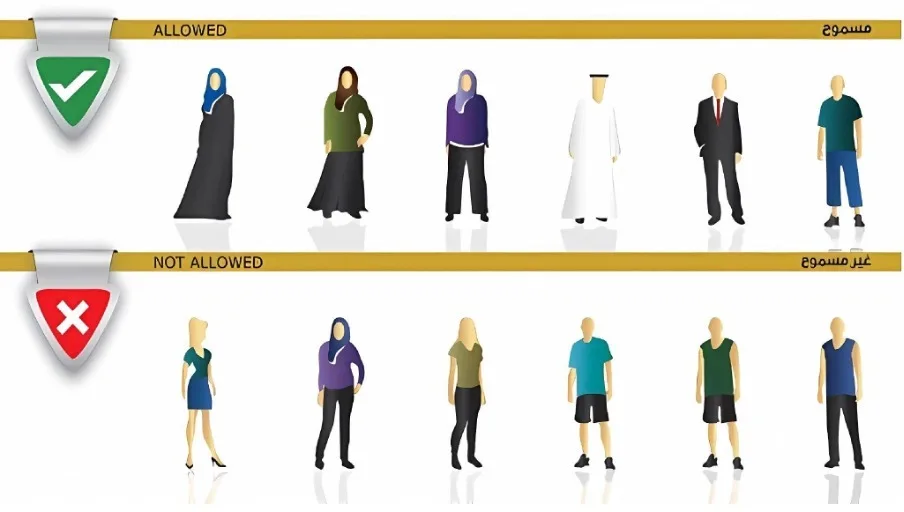
Dress Code in Dubai: Combining Tradition and Modernity
Dubai, where traditional customs and modern trends form a unique cultural space, requires a special approach to wardrobe selection. Respect for local norms, especially regarding the dress code, is an integral aspect of comfortable stay in this metropolis.
● Public zones and conservative areas: In these sectors of urban life, modesty in clothing is prioritized. It is unacceptable to wear clothes with transparent elements or overly revealing ensembles.
● Private beaches and pools: Here, wearing swimsuits is allowed, but outside of these zones, it is strongly recommended to change into a more modest outfit.
● Gender issue and clothing choice: Violation of social norms in terms of clothing choice, including wearing items traditionally associated with the opposite sex, can lead to undesirable consequences, including legal problems.
● Zones with more lenient rules: In some areas of Dubai, more relaxed styles of clothing, such as shorts and t-shirts, are allowed. Nevertheless, the principle of moderation and modesty remains important.
● Mosques and religious sites: When visiting such places, it is customary to observe a strict dress code that requires full coverage of shoulders, arms, and legs.
● Headwear for women: Women visiting mosques are advised to wear a headscarf as a sign of respect for local religious customs.
Understanding and observing these basic but extremely important principles will ease adaptation in Dubai and help avoid unnecessary misunderstandings in this impressive city, where modernity and tradition are in harmony.
Specifics of Inappropriate and Offensive Gestures within the Cultural Characteristics of the United Arab Emirates
For a deep and productive intercultural dialogue, not only language proficiency is needed, but also an awareness of the subtleties of the partner country’s culture. The United Arab Emirates, having a distinct cultural identity, include a number of specific gestures that may be misinterpreted and perceived as offensive or inappropriate. This analytical review aims to shed light on important aspects of these gestures to prevent possible cultural clashes and misunderstandings when interacting with the local population of the Emirates.
- The “Thumb Fan” gesture: This gesture, in which four fingers are clenched into a fist while the thumb is splayed out, has a negative connotation within the UAE culture and is often perceived as a lack of respect for the interlocutor.
- Pointing with a finger: A directive movement with one index finger in the context of communication can be perceived as an intentional demonstration of hostility or disrespect. When communicating in the Emirates, it is far more acceptable to use the whole palm to indicate direction or object.
- Avoiding direct eye contact: The importance of direct eye contact in communication is a key element of communication in the UAE. It is considered that avoiding eye contact or inconsistent gaze, moving from one eye to another, can be perceived as a blatant display of disrespect.
- Offering the left hand for a handshake: According to Arabic culture traditions, the left hand is usually associated with “unclean” actions. Therefore, offering a handshake with the left hand is perceived as a rude violation of etiquette norms.
- Crossing legs: In the context of UAE culture, showing the soles of shoes or crossing legs, especially when sitting across from another person, can be taken as an insult, as the sole of the shoe is traditionally associated with dirt and filth.
Understanding and respecting the cultural characteristics and traditions of the UAE are key factors for successful intercultural dialogue. Keep in mind the above-mentioned rules when communicating with Arabs to avoid misunderstandings and create a positive impression.
The Importance of Adherence to UAE Legislation: An Overview of General Behavior Rules
In the context of the strict legislation of the United Arab Emirates, knowing and observing the existing rules of conduct in public spaces is of paramount importance. Ignoring these norms can lead to negative consequences, including criminal prosecution.
● Inappropriate manners of communication: Public display of gestures that may be interpreted as offensive or demeaning can be grounds for arrest and subsequent imprisonment. It is always necessary to communicate with respect and maintain decent behavior to prevent conflict situations.
● Alcohol intoxication and drunk driving: The United Arab Emirates categorically do not tolerate people appearing in a drunken state on the streets and public spaces, as well as driving vehicles under the influence of alcohol. Violating these prohibitions can result in punishment in the form of a fine, arrest, or even imprisonment.
● Photography: When taking photos, always show tact and get prior permission from the people being photographed, especially if they are women. Thoughtless shooting can lead to misunderstandings and cause conflict situations.
● Consumption of alcohol and prohibited substances: The intake of alcohol in public spaces and storing alcohol or other banned substances is absolutely unacceptable at any time. Non-compliance with this rule can lead to severe fines or arrest.
● Public displays of affection: In the UAE, public kissing and hugging are categorically unacceptable. Holding hands is allowed, but all other displays of affection should be minimized.
Below is a table showing types of unacceptable behavior and their potential consequences:
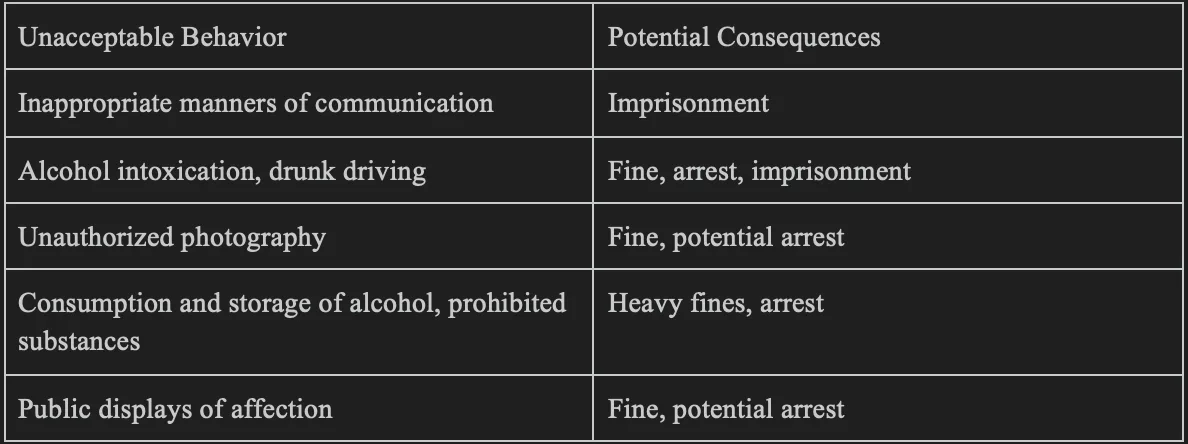
It is necessary to not only remember the above rules but to strictly adhere to them to prevent unwanted consequences during your stay or residence in the United Arab Emirates.
Full Relocation Assistance to the UAE with Polaris: Visa Processing and Legislative Consultation
Our Polaris team provides expert assistance in relocating between countries, including ensuring proper visa processing and compliance with UAE legislation. With a deep understanding of immigration law, Polaris specialists handle visa requirements, simplifying the visa application process.
The comprehensive consultations on UAE laws we provide will help you avoid legal complexities. The efficiency and timeliness of visa application processing is ensured through our specialists’ meticulous oversight.
At Polaris, we strive to provide a comfortable and smooth relocation, overcoming bureaucratic hurdles. By choosing us as your relocation partner, you will receive trustworthy and professional support.