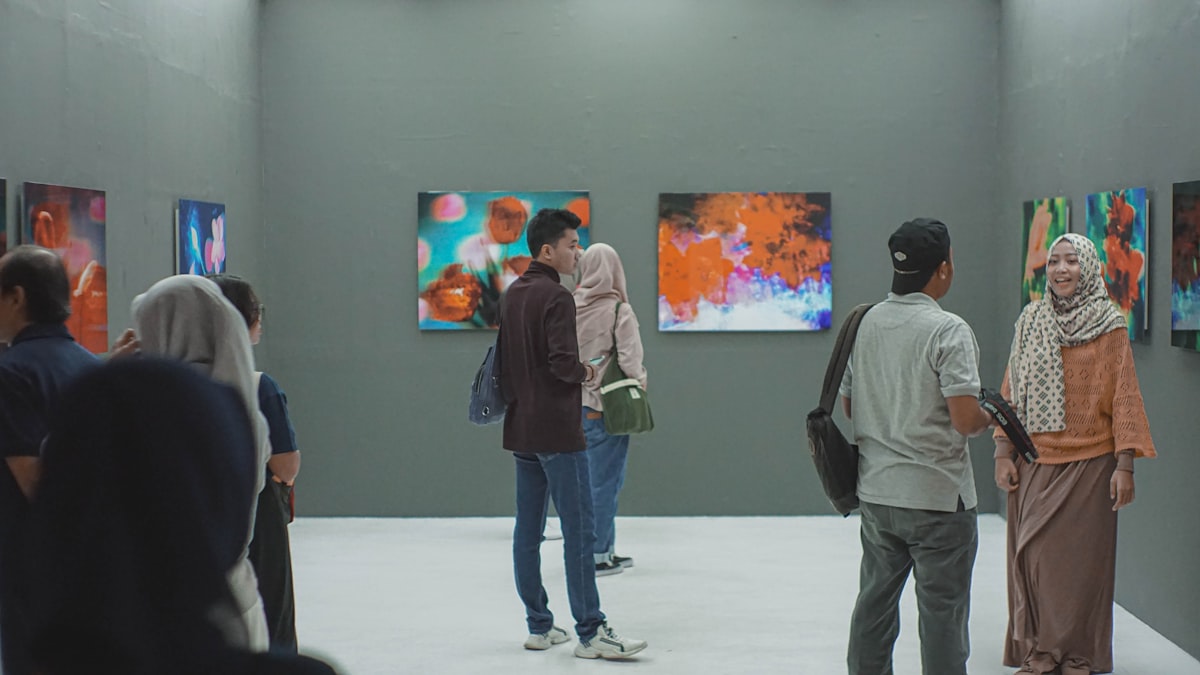
Art Dubai closed the doors on its twentieth edition in the third week of May 2026. For three days at Madinat Jumeirah, around seventy-five gallery and institutional presentations drew collectors, curators, students and the simply curious — and, in a decision that says as much as any artwork on the walls, admitted all of them free of charge. Two decades ago, the idea of an international art fair anchoring a cultural season in Dubai would have struck most observers as aspirational at best. In 2026 it is simply part of the calendar, and in some ways the least interesting thing about it is the fair itself.
What sits behind Art Dubai is the real subject of this article: a year-round cultural economy that the UAE has built deliberately, funded seriously, and now counts as part of its strategic and investment story. For a corporate-services firm whose clients are deciding where to base a business, settle a family or place capital, the strength of a city's cultural life is not a soft footnote. It has become a hard input into the decision — the difference, often, between a posting and a home. This article takes both halves in turn: the culture Dubai has assembled, and the economics that now run underneath it.
Art Dubai at twenty
The fair's 2026 edition was a deliberate landmark. It brought together roughly forty-five commercial galleries — about sixty per cent of them from the wider region — alongside some thirty institutional programmes, for more than seventy-five presentations in total. That regional weighting is the point of the whole enterprise. Art Dubai is not a satellite of London, Basel or Paris; it has positioned itself as the principal international fair for the art of the Middle East, South Asia and Africa, a part of the art world that the established Western fairs have historically under-served. When a Lagos or Karachi or Beirut gallery shows in Dubai, it is showing at home in a way it never quite is elsewhere.
Around the commercial booths runs a programme that has grown into a genuine intellectual event. The Global Art Forum, the fair's discursive arm, reached its own twentieth edition in 2026 under curator Shumon Basar; the Dubai Collection presented "Made Forward," a panorama of the modern and contemporary art the emirate has been quietly assembling; the Barjeel Art Foundation mounted an exhibition of modern Arab art, and the Sharjah Art Foundation contributed a programme built around performance. And then there was the entry policy. By making admission free to everyone in its twentieth year, Art Dubai converted itself from a trade event into a civic one — opening the doors to students, young creatives and first-time visitors who would never have bought a ticket. A government and an organiser do not make a fair free unless the goal is reach rather than revenue.
Alserkal Avenue: the engine room of the scene
A fair is a moment. A scene needs permanent infrastructure, and Dubai's sits in an unglamorous place: the industrial warehouses of Al Quoz. Alserkal Avenue was established there in 2008 by Abdelmonem Bin Eisa Alserkal, who saw in a row of light-industrial units the raw material for a cultural district. It now spans roughly 500,000 square feet — its footprint doubled in a 2015 expansion — and houses a community of more than seventy contemporary-art galleries, arts organisations, studios, designers and creative businesses, along with residencies, performance venues, cafés and the social spaces that turn a complex of galleries into a place people actually spend time.
The Alserkal model matters because it is the opposite of a one-off spectacle. It is a privately-led, patiently-built piece of cultural infrastructure — a patron converting warehouses, year after year, into the ecosystem that the rest of the scene draws on. Its Quoz Arts Fest has drawn crowds of around forty thousand over a single weekend; its programming arm supports artists from across the Middle East, North Africa and South Asia. Most of the galleries that fill Art Dubai's booths each spring have a permanent address, and a great many of them have it here. The fair is the harvest; Alserkal is a good part of the soil.
A city with a cultural calendar
Beyond the fair and Alserkal, what Dubai has assembled over the past fifteen years is a calendar — a cultural life that runs through the year rather than spiking once and going quiet. The SIKKA Art & Design Festival, created in 2011 by Dubai Culture to showcase emerging Emirati and GCC artists, unfolds through the historic lanes and courtyard houses of Al Shindagha and has drawn well over two hundred thousand visitors in a single recent edition. The Jameel Arts Centre, on the banks of Dubai Creek, is a permanent contemporary-art institution with substantial gallery space, a sculpture park and a series of desert gardens. Dubai Design District — d3 — spans some 1.8 million square feet and helped earn Dubai its designation as a UNESCO Creative City of Design.
Add the rest — World Art Dubai, Downtown Design, gallery nights, museum programming, public-art commissions — and the cumulative effect is a city where culture is no longer an import flown in for one week each year. It is produced locally, shown continuously, and pitched at every level from the blue-chip collector to the schoolchild on a free pass. The range is deliberate: heritage and the avant-garde, the commercial and the civic, the homegrown and the international, held in the same calendar.
Who is in the room
Twenty years ago, the buyers at a Gulf art fair were overwhelmingly international — collectors and dealers flying in for the week. That has changed. A large and growing share of the activity at Art Dubai and across the city's galleries now comes from the region itself: Emirati and GCC collectors, families building collections meant to pass between generations, and a notably younger cohort buying earlier in their careers than their predecessors did. Institutions collect too — the Dubai Collection is a public collection being assembled on behalf of the emirate, and the museums of Abu Dhabi acquire on a scale of their own. A market with a deep domestic collector base behaves very differently from a fair dependent on fly-in demand: it has a floor under it, and a memory.
The supply side has localised in the same way. Artists increasingly choose to be based in the UAE rather than merely to exhibit there; galleries represent regional artists as a matter of programme, not tokenism; residencies, art schools and a serious critical conversation have grown up alongside the commercial scene. The result is an ecosystem with all four of its parts in place: artists who make the work, galleries and fairs that distribute it, collectors and institutions that buy it, and the connective tissue of criticism, education and discourse that gives it meaning. A city can rent an event. It has to grow a market — and that completeness is the difference between the two.
From trading post to cultural capital
It helps to see this as the latest layer in a familiar pattern. Dubai built itself in stages. It began as a trading port, a place where goods and dhows changed hands. It became a logistics and aviation hub, then a financial and professional-services centre, then one of the most-visited tourist cities on earth. Each layer was the platform for the next; none replaced what came before. Culture is simply the newest layer, and it could only be built once the others were in place — once there was the wealth, the population, the connectivity and the confidence to support it.
It is also the hardest layer to fake and, once built, among the most valuable. Tax regimes can be copied and free zones replicated; a credible cultural scene takes decades and cannot be conjured by decree. What it signals is permanence — that a place is somewhere people build a life and a community, not merely somewhere they optimise a balance sheet. That signal is precisely what a city wants to send to the talent, the families and the long-term capital it is competing for. Which is why, for the UAE, culture has stopped being an amenity and become a strategy — the subject of the second half of this article.
Related Insights
Why Global Entrepreneurs and Public Figures Are Making the UAE Their HomeThe reasons go beyond tax — safety, connectivity, banking and, increasingly, cultural life.The Golden Visa Keeps Widening: Nurses, Founders and the May 2026 UpdatesHow the UAE's long-term residency system has broadened — including routes for creative talent.UAE Economic Performance in 2026: Key Indicators and What They MeanDiversification, non-oil growth and where the creative economy fits in the wider picture.The creative economy, in numbers
Strip away the openings and the gallery walls and a set of hard targets comes into view. The UAE's National Creative Strategy aims for the creative industries to contribute ten per cent of GDP by 2031, with the sector projected to add on the order of AED 200 billion to the economy by 2030. Dubai's own Creative Economy Strategy set a nearer-term goal: to roughly double the creative industries' share of the emirate's GDP, from 2.6 per cent in 2020 to 5 per cent. Employment in the creative sector is targeted at around one million jobs by 2027, and the emirate has aimed to host some five thousand creative startups. These are not the figures of a vanity project. They are the figures of an industrial policy.
| Indicator | Figure |
|---|---|
| Creative industries' projected GDP contribution by 2030 | On the order of AED 200 billion |
| UAE National Creative Strategy GDP goal | 10% of GDP by 2031 |
| Dubai creative industries' share of GDP | 2.6% (2020), 5% targeted |
| Cultural & Creative Talents Golden Visas issued (2023) | Around 5,000 |
| Creative-sector employment target | ~1 million jobs by 2027 |
| Creative startups targeted | ~5,000 |
Why a government treats culture as economic policy
To a sceptic, public money spent on art looks like discretionary spending — pleasant, prestigious, but separable from the serious business of the economy. The UAE's bet is the opposite, and it rests on the observation that culture does measurable economic work. It lengthens the time visitors stay in a city and raises what they spend while there. It differentiates a destination in a region where sun, shopping and hotels have long since ceased to be distinguishing features. It attracts and — the harder part — retains the skilled, mobile professionals who can choose almost any city in the world, and who increasingly choose on the basis of whether there is a life to be had beyond the office. And it lifts the value of the real estate that surrounds a cultural district, a pattern visible from Bilbao to Abu Dhabi's own Saadiyat Island.
Underneath those mechanics sits the larger strategic logic. An economy diversifying out of hydrocarbons into trade, finance and tourism still faces a question that spreadsheets do not answer: will the people it attracts actually stay? Culture is the layer that converts a destination into a domicile. It is what changes the honest expatriate calculation from "a good few years" to "this is where we live." A government that has understood that — and the UAE plainly has — will treat museums, fairs and creative-sector incentives not as ornament but as infrastructure, and fund them accordingly.
Culture and the value of place
The place culture turns up most plainly on a balance sheet is real estate. The international shorthand is the "Bilbao effect," after the single museum that reframed an entire post-industrial city — and the UAE has applied that logic deliberately and at scale. Cultural anchors lift the desirability, the footfall and ultimately the value of the districts around them. Al Quoz, an unremarkable industrial quarter, acquired a different character once Alserkal Avenue gave it a cultural centre of gravity. Dubai Design District was conceived from the outset as a place where creative business and real estate reinforce one another. The pattern is consistent: where culture goes, a particular kind of value tends to follow.
For an investor or a relocating family, that pattern rewards being read deliberately rather than noticed in hindsight. Districts with genuine cultural infrastructure tend to attract long-term residents rather than transient ones, and long-term residents are what stabilise a neighbourhood and underpin its property values. Culture, in that sense, is not only an amenity to enjoy once you have chosen where to live. It is also a signal — about which parts of a city are being built to last, and where the kind of community that holds value is most likely to form.
The Cultural and Creative Talents Golden Visa
The clearest expression of that thinking is a visa. The UAE built a Cultural and Creative Talents track into its Golden Visa system: a ten-year residency open to artists, designers, writers, filmmakers, musicians, digital content creators and other creative professionals, granted without the need for a corporate sponsor. Around five thousand such visas were issued in 2023 alone. It is the same long-horizon logic the country already applies to investors, entrepreneurs and scarce professionals, now extended to the creative economy.
The reasoning is sound, because a creative city cannot be built on talent that has to leave every two years. An artist or a designer or a film producer makes location decisions over a career, not a contract; a two-year, employer-tied visa quietly tells that person they are a guest. A ten-year, self-sponsored residency tells them something different — that they can put down roots, take a studio, start a company, raise a family. For the creative professional and the creative business alike, the visa converts the UAE from a place to visit into a place to build, which is exactly the conversion the wider strategy depends on.
What it means for businesses, investors and families
For the audience Polaris works with, three readings follow. The first is sectoral: the creative economy — media, design, content, events, the art trade, the fast-growing intersection of culture and technology — is now an investable sector in the UAE with explicit policy momentum behind it. A business does not have to be a gallery to participate in it. The second is residential: for an executive or a family weighing a multi-year move, a deep and genuine cultural scene is a real liveability factor. It is a large part of the answer to the question every relocating family eventually asks — is there a life here, and not only a job — and it materially improves the odds that a relocation lasts.
The third reading is about assets. As Dubai has become a place to buy, hold and exhibit art, the art itself has become an asset class that the firm's clients increasingly own — and an art collection, like any other significant holding, behaves better inside a deliberate structure than outside one. The cultural turn, in other words, does not only change the city's character. It adds a category of asset and activity that the same structuring discipline applied to companies, property and investments should now be applied to.
The structuring questions
For those whose interests run into the cultural economy, a handful of structuring questions recur. How should an art collection be held — in a personal name, a company, or a foundation — given the demands of succession, insurance, confidentiality and an eventual sale? How should a creative business be structured, and how should its intellectual property — often its single most valuable asset — be owned and protected? What is the right vehicle for cultural philanthropy, where a foundation usually answers better than ad hoc giving? And how does the Cultural and Creative Talents visa fit into a broader relocation and corporate plan? None of these questions is unique to art. They are the ordinary questions of structuring — applied to an asset class that has now grown large enough in the UAE to deserve them.
A practical note on timing. For most of the past two decades, structuring questions around art and the creative economy were genuinely niche in the UAE — there was simply not yet enough activity to warrant them. That is no longer true. A collection assembled in Dubai today can represent a material share of a family's wealth; a creative business here can carry real enterprise value locked up in its intellectual property; cultural philanthropy has grown substantial enough to merit its own dedicated vehicle. The cost of structuring any of these well is modest set against the cost of getting succession, a sale or a tax position wrong — and, as with every other asset class, the work is far easier done early than retrofitted later.
- Art Dubai marked its 20th edition in May 2026 — around 75 presentations, ~45 galleries (60% regional), free entry for all — but the fair is the visible peak of a far larger cultural economy.
- Permanent infrastructure underpins the scene: Alserkal Avenue (70+ galleries in Al Quoz), the Jameel Arts Centre, Dubai Design District, and a year-round calendar that includes SIKKA.
- Culture is explicit UAE economic policy: creative industries are targeted at 10% of GDP by 2031 and roughly AED 200 billion by 2030; Dubai aimed to double its creative GDP share from 2.6% to 5%.
- The Cultural and Creative Talents Golden Visa gives artists and creative professionals 10-year residency without a sponsor — around 5,000 issued in 2023.
- For businesses, investors and families, a deep cultural scene is a hard input into where to base, invest and live — and art collections and creative enterprises reward proper structuring.
Polaris Perspective
A serious cultural scene is one of the quieter reasons the UAE has become a place people commit to rather than simply pass through. Polaris advises businesses, investors and families on corporate structuring, foundations for collections and philanthropy, and long-term residency — including the Cultural and Creative Talents route. If your interests run into the UAE's creative economy, we can help you structure them as carefully as any other part of your affairs.
Arrange a Consultation →