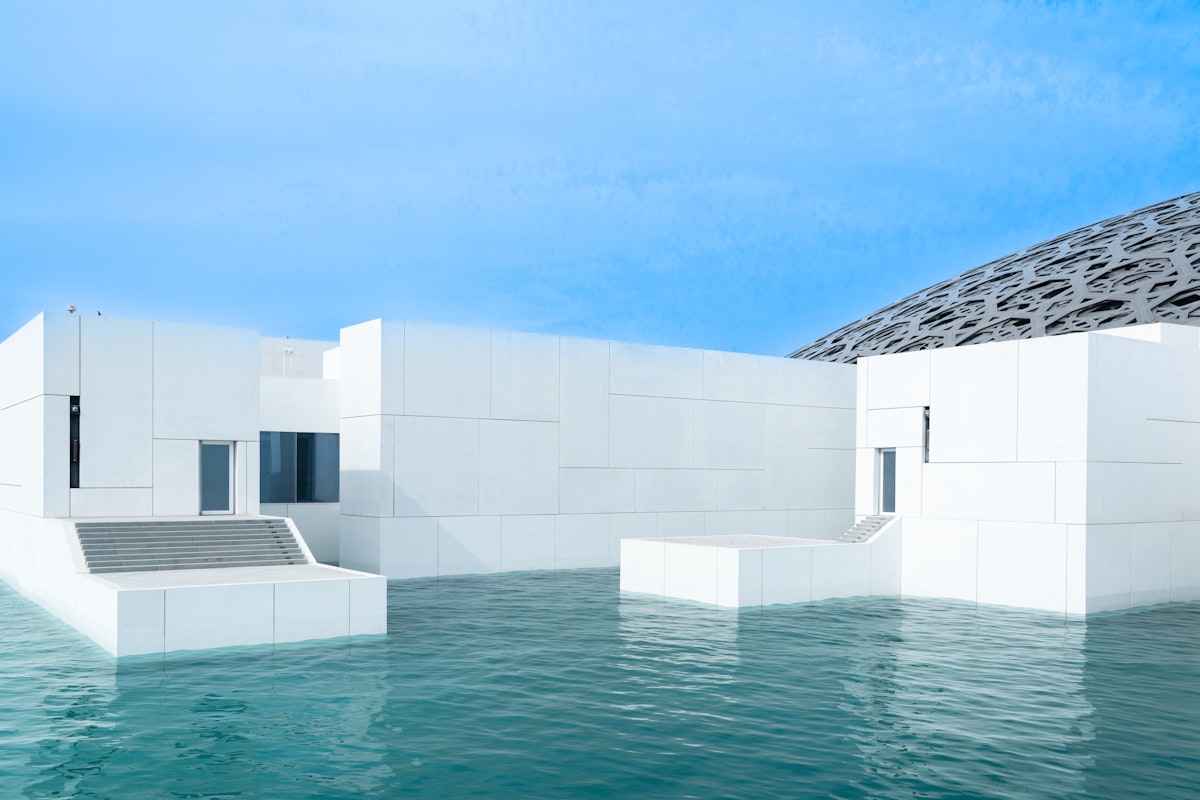
For nearly twenty years, the Saadiyat Cultural District existed mostly as an idea and a set of architectural renderings. The masterplan was extraordinary — a cluster of world-class museums on a natural island off the coast of Abu Dhabi, each designed by one of the most celebrated architects alive — but for most of those two decades only a single one of its buildings, the Louvre Abu Dhabi, had actually opened its doors. In 2025 that changed, decisively. Three major museums opened within eight months of one another, and the Guggenheim Abu Dhabi, the cluster's long-awaited keystone, moved within clear sight of completion. A vision two decades in the making became, almost all at once, a real place.
This article looks at what that means — and it looks at it deliberately twice. The first half is the culture: what is now actually standing on Saadiyat, building by building, and why the cluster matters as a cultural achievement. The second half is the economics: what a completed museum district does to a tourism economy and a property market, and what it means for the investors and families that Polaris advises. Saadiyat is, at the same time, one of the most ambitious cultural projects of the century and a very large, very deliberate economic bet. Both things are true, and both are worth understanding clearly.
The island and the idea
Saadiyat is a 25-square-kilometre natural island a short drive from downtown Abu Dhabi, edged with white-sand beaches and developed as a mixed-use district by the Abu Dhabi government in partnership with the global engineering firm AECOM. Its masterplan provides for a resident population on the order of 150,000, alongside hotels, schools and visitor attractions; the Cultural District is one designed component of that larger whole. The idea behind it, conceived in the mid-2000s, was audacious by any standard: not one landmark museum but an entire quarter of them, each by a different architect of global stature, on a single island — Jean Nouvel for the Louvre, Frank Gehry for the Guggenheim, Foster + Partners for the Zayed National Museum.
The strategic thinking behind that ambition is worth pausing on. Abu Dhabi holds the overwhelming majority of the UAE's hydrocarbon reserves; of all the emirates, it was the one least immediately obliged to diversify its economy. It chose to anyway, early and deliberately, under the long-term programme that became Abu Dhabi's economic vision for 2030. And it placed culture close to the centre of that diversification rather than at its margin. The Saadiyat masterplan was the physical expression of a decision — that Abu Dhabi would compete in the world not on beaches, hotels and sunshine alone, but as a centre of art, knowledge and learning. Building five museums is one way of saying so in a form that cannot be mistaken.
Louvre Abu Dhabi: the anchor
The Louvre Abu Dhabi opened in 2017, the first piece of the cluster and, for eight years, the only one. Jean Nouvel's design — a vast, seemingly weightless dome, perforated so that sunlight filters through it in a shifting, dappled pattern the architect called a "rain of light" — became instantly and globally iconic. But the more radical element was the institution's premise. It is a "universal museum": rather than confining itself to Islamic or regional art, it tells a single, chronological story of human creativity across civilisations, deliberately placing objects from different cultures and eras side by side so that the connections between them become the point.
It rests on an intergovernmental agreement with France — covering the use of the Louvre name, loans from French national collections, and curatorial expertise — under a long-term arrangement between the two states. And it has worked as a visitor proposition in plain numerical terms: the Louvre Abu Dhabi drew around 1.4 million visitors in 2025, one of the most-visited cultural sites anywhere in the country. For eight years it carried the cultural district more or less single-handedly, and in doing so it proved the model — demonstrating that a world-class museum on Saadiyat would draw the audiences the masterplan had promised — well before the rest of the cluster arrived to join it.
The class of 2025: three museums in eight months
The first of the new arrivals was the most unexpected. teamLab Phenomena Abu Dhabi opened on 18 April 2025, and it is something genuinely new: a 17,000-square-metre museum given over entirely to immersive digital art by the Japanese collective teamLab — the largest digital-art museum in the world. Its twenty-five works are not paintings hung on walls but environments: spaces of light, water and movement that respond to the people inside them and never repeat themselves. The museum is divided into "dry" and "wet" zones — in the latter, visitors remove their shoes and wade through shallow water — and installations with names such as Biocosmos and Levitation Void treat natural phenomena themselves as the artistic medium. It is the cluster's deliberate bid for a younger, experience-seeking audience, and a substantial visitor draw in its own right.
Then, within weeks of one another at the close of the year, came two institutions of an entirely different character. The Natural History Museum Abu Dhabi opened on 22 November 2025, telling the story of the natural world — deep geological time, the earth, the emergence and variety of life — on a scale designed to stand alongside its neighbours. And on 3 December 2025 the Zayed National Museum opened: the national museum of the UAE itself, housed in a Foster + Partners building whose soaring towers evoke the wing feathers of a falcon, and devoted to the history, the culture and the identity of the nation and the legacy of its founding president, Sheikh Zayed bin Sultan Al Nahyan. In the space of eight months, Saadiyat went from one museum to four.
Guggenheim Abu Dhabi: the keystone still to come
The cluster's final and largest piece is still ahead. The Guggenheim Abu Dhabi, designed by Frank Gehry, has been the most delayed element of the entire masterplan — and, by early 2026, is widely described as close to completion, although no official opening date has yet been confirmed. When it does open, expected to be the largest Guggenheim museum in the world, it will give the district a dedicated home for modern and contemporary art and complete the architectural set that the masterplan envisaged two decades ago.
The long wait for the Guggenheim is, in its own way, the most instructive part of the story. A cluster of this ambition was never going to arrive on schedule or all at once; it has taken twenty years, several well-publicised delays and an enormous, sustained commitment of capital and political will. That it is now all but finished — rather than abandoned, indefinitely stalled or quietly downscaled, which is the eventual fate of a great many grand cultural masterplans elsewhere in the world — is the genuine headline. Saadiyat belongs to the small category of cultural mega-projects that have actually been delivered, more or less as promised.
A district, not a row of museums
It would be a mistake to picture Saadiyat as five museums standing in a line. The Cultural District sits inside a wider island that has been built, deliberately, as a place to live, study and stay. The Abrahamic Family House — a church, a mosque and a synagogue sharing a single site, opened in 2023 — gives the district a civic and interfaith dimension that no museum could supply. Manarat Al Saadiyat is a long-established arts and exhibition centre. NYU Abu Dhabi, a full degree-granting campus of New York University, and Berklee Abu Dhabi anchor the island in higher education and music. Around all of it are beaches, hotels and residential communities. The museums are the headline, but the district is the actual product: a place where culture, education, faith and ordinary daily life have been woven together on purpose.
| Institution | Opened | What it is |
|---|---|---|
| Louvre Abu Dhabi | 2017 | Jean Nouvel's domed universal museum; ~1.4m visitors in 2025 |
| teamLab Phenomena | April 2025 | A 17,000 sqm immersive digital-art museum — the world's largest |
| Natural History Museum Abu Dhabi | November 2025 | Natural history and science, from deep time onward |
| Zayed National Museum | December 2025 | The national museum of the UAE — history, culture and identity |
| Guggenheim Abu Dhabi | Expected | Frank Gehry-designed contemporary-art museum, nearing completion |
Related Insights
Dubai's Art Season: Art Dubai at Twenty and the Economics of a Creative CityThe companion piece — how Dubai built a year-round cultural economy, and why it matters.Dubai Property and the Institutional TurnHow institutional capital reads UAE real estate — the same underwriting logic applies to Saadiyat.UAE Economic Performance in 2026: Key Indicators and What They MeanDiversification, non-oil growth and the place of tourism and culture in the wider economy.What a museum cluster does to a tourism economy
The cultural district is not only a cultural project; it is a tourism engine, and the 2025 figures show it running. Abu Dhabi welcomed a record 26.6 million visitors over the year. Hotel revenues rose 19.5 per cent, to AED 9.1 billion. More than 8.6 million visits were made to the emirate's cultural sites and libraries across 2025. And in the first half of the year alone, visits to cultural and heritage sites jumped 47 per cent year-on-year, to more than four million. Those are not the numbers of a marketing campaign; they are the numbers of a structural shift in why people come to Abu Dhabi at all.
The figures matter because of what cultural tourism does that beach and shopping tourism do not. A visitor who comes for museums tends to stay longer, spend more while there, and come back — and a cluster of five world-class institutions gives a city a credible reason for a multi-day visit rather than a single-night stopover between flights. The hotel data tracks it directly: revenue per available room reached AED 446 in the first half of 2025, up 24 per cent year-on-year. Culture, in Abu Dhabi's case, is measurably converting itself into hotel nights, restaurant covers, repeat visits and the kind of higher-value tourism that a diversified economy is built to capture.
The Saadiyat property story
The second economic effect is on property, and it is the one most directly relevant to investors. Saadiyat Island sits within a designated freehold zone, which means foreign nationals can buy, own and sell property there outright, in their own name or through a structure. The island offers the full spectrum of homes — apartments, townhouses, villas and branded residences — much of it within walking distance of the museum cluster, the beaches and the schools. And the cultural district has done to Saadiyat property very much what the international "Bilbao effect" would predict: a single concentration of world-class culture lifting the desirability, and the value, of everything around it.
The data bears that out. Abu Dhabi prime residential values rose 6.1 per cent year-on-year in 2024, with Saadiyat Island leading the emirate; luxury villa transaction volumes grew by close to 30 per cent year-on-year across 2023 and 2024, outpacing the wider city. The underlying logic is straightforward. A finite supply of homes on a 25-square-kilometre island, wrapped around a cultural and educational district that quite simply cannot be replicated elsewhere, is precisely the kind of scarce, amenity-rich real estate that holds and compounds value. And the completion of the museum cluster through 2025 did something specific to that proposition: it removed the last "will this actually happen" discount that a half-built masterplan had always carried.
Culture, soft power and diversification
Stand back, and Saadiyat reads as a case study in why a wealthy state spends so heavily on culture. The narrow answer is diversification: tourism, hospitality and the creative economy are non-oil revenue, and a museum district is durable, decades-long infrastructure that feeds all three. The broader answer is soft power. A Louvre and a Guggenheim do for a nation's standing what very few other investments can — they place it, permanently and visibly, on the world's cultural map, and they signal seriousness, openness and a long time horizon to everyone watching. The Abrahamic Family House makes a parallel statement, about tolerance and coexistence, in a form the whole world can read. None of this shows up cleanly on a quarterly return, but all of it compounds — and a government with a multi-decade horizon is exactly the kind of actor positioned to collect on it.
Two models, one country
It is worth placing Saadiyat alongside what has been happening ninety minutes up the road in Dubai, because the two emirates have pursued culture in genuinely different ways — and the difference is instructive. Abu Dhabi's model is institution-led and state-directed: a small number of very large museums, internationally branded, designed by famous architects and delivered through government and sovereign investment over a twenty-year horizon. Dubai's model is market-led: a dense ecosystem of commercial galleries, an international art fair, design districts and creative-economy incentives, grown largely through private patronage and entrepreneurial energy. One emirate built cathedrals; the other grew a marketplace.
Neither approach is the "correct" one, and the more interesting observation is that the UAE now has both. A visitor, an investor or a relocating family encounters a cultural offer that runs the full range — from the blue-chip national museum to the emerging commercial gallery, from the state institution to the working artist's studio — an unusually complete spectrum for a country of the UAE's size and age. For Polaris's clients, the practical implication is straightforward: "the UAE" is not a single cultural proposition but two complementary ones. The choice between Abu Dhabi and Dubai — for a home, a base or an investment — can now legitimately turn, in part, on which of the two cultural models suits a particular family or business better.
What it means for investors and families
For an investor, Saadiyat is now a maturing proposition rather than a speculative one. The cultural district is essentially built; the completion risk that hung over it for two decades is gone; and the property market beneath it has a genuine structural floor — a scarcity of island land, an amenity base that cannot be copied, a freehold regime that admits foreign capital, and a tourism economy that keeps expanding around it. For a family weighing Abu Dhabi, the calculation is different but closely related. A completed cultural and educational district — museums, NYU, Berklee, the Abrahamic Family House, beaches and schools gathered on one island — is precisely the kind of environment that makes a long-term relocation sustainable, and that matters most acutely where children and a multi-year horizon are involved.
The two readings converge on a single point. Saadiyat has crossed the line that separates a place you watch being built from a place you can actually commit to — as a visitor, as a resident, or as an owner. That shift, from promise to proven, is the most consequential thing the events of 2025 accomplished, and it is the lens through which the investment and relocation decisions now deserve to be made.
The structuring questions
For those acting on that — buying on Saadiyat, relocating a family, or holding the property as an investment — the structuring questions are the familiar ones, and they reward being answered before the purchase rather than after it. How should the property be held: in a personal name, or through a company or other vehicle, given the consequences for succession, liability and an eventual sale? Does the purchase support a residency route, and if so, is that route being used deliberately and to full effect? How does Abu Dhabi freehold ownership sit within the family's wider estate and succession plan? Saadiyat is a particularly attractive asset — which is exactly the reason to hold it inside a considered structure rather than a default one.
One point applies with particular force on Saadiyat. Because the district is now complete and proven, demand for its limited housing stock is unlikely to soften — which means the practical work of structuring a purchase is best done in advance of, rather than after, a competitive transaction. A buyer who has already settled how the asset will be owned, how it connects to a residency application, and how it sits within a wider succession plan moves faster, and from a stronger position, than one improvising those decisions in the middle of a deal. On an island where the supply is fixed and the proposition is now established, that preparation is itself a real advantage.
- Saadiyat's cultural district essentially completed in 2025: teamLab Phenomena (April), the Natural History Museum (November) and the Zayed National Museum (December) joined the Louvre Abu Dhabi, with the Guggenheim close behind.
- The Louvre Abu Dhabi (2017, Jean Nouvel) anchored the district for eight years and drew around 1.4 million visitors in 2025.
- teamLab Phenomena is the world's largest digital-art museum at 17,000 sqm; the Zayed National Museum, by Foster + Partners, is the national museum of the UAE.
- Culture is a measurable tourism engine: Abu Dhabi drew a record 26.6 million visitors in 2025, cultural-site visits rose 47% in H1, and hotel revenue reached AED 9.1 billion.
- Saadiyat is a freehold zone; prime values led Abu Dhabi in 2024 (+6.1%) and luxury villa transactions rose ~30% — and the cluster's completion removes the old 'completion risk' discount.
- For investors and families, Saadiyat has shifted from a project to watch into an asset and a place to commit to — and a particularly attractive asset rewards deliberate structuring.
Polaris Perspective
Saadiyat's completion is a milestone for Abu Dhabi and a clear signal for anyone weighing the emirate: the cultural district is no longer a promise but a place. Polaris advises investors and families on property holding structures, UAE residency including the property route, and the succession planning that a significant real-estate asset deserves. If Saadiyat is on your map — as an investment or as a home — we can help you hold it well.
Arrange a Consultation →